
WorkLattice
Structural Visibility for Strategy Execution
Organisations rarely fail because they lack strategy.
They fail because the structure responsible for executing that strategy cannot reliably produce the outcomes that were declared.
Policies exist. Responsibilities are assigned. Governance frameworks are documented.
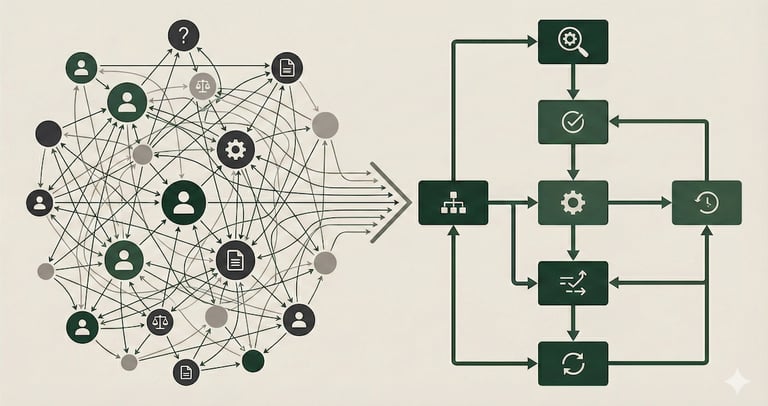
But behaviour follows the decision architecture actually embedded in the organisation, not the one described in diagrams.
WorkLattice makes that architecture visible.

What is WorkLattice
Decision Architecture Analysis
Translate governance documentation into a structural map of how authority, verification, and escalation actually flow through the organisation.
Reveal how decisions move through policies, delegations, and procedures.
Identify where the operating model structurally supports or constrains execution.
Structural Pattern Detection
Analyse the decision architecture to detect structural failure signatures that affect delivery.
Identify authority gaps, broken execution chains, escalation dead-ends, and decision bottlenecks.
Surface hidden structural conditions shaping organisational behaviour.
Provide leaders with a clear view of the structural capacity of the organisation to deliver its strategy.
Reveal where execution pathways are resilient, fragile, or overloaded.
Support informed redesign of governance, operating models, and decision systems.
Execution Structure Insight
Why is WorkLattice Useful
In complex organisations, execution problems are often attributed to leadership capability, culture, or individual performance.
However, many persistent issues arise from structural conditions embedded in governance and operating models.
When decision pathways are fragmented, responsibilities overlap, or escalation cannot reach resolution points, the organisation behaves according to those structural constraints regardless of intent.
WorkLattice makes these conditions visible, allowing leaders to see where the system itself is enabling delivery and where it is structurally preventing it.